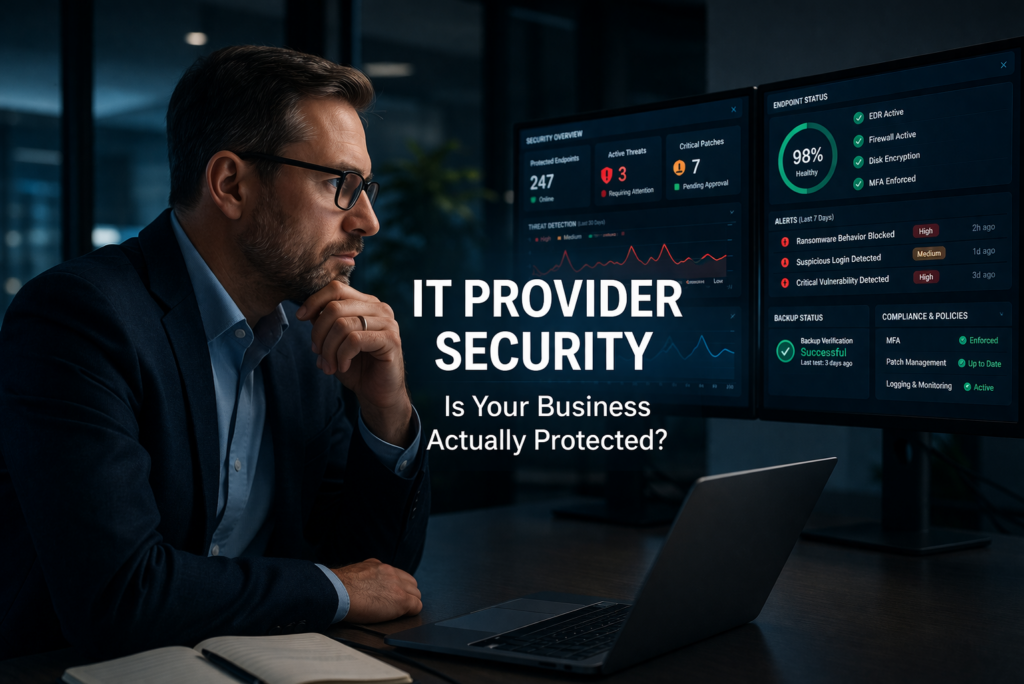
IT provider security is one of the most misunderstood risks in business today.
Most organizations believe their IT provider is protecting them.
Systems are running. Tickets are getting resolved. Updates are being applied.
On the surface, everything appears to be working.
But operational stability and true protection are not the same thing.
The gap between those two is where real risk lives.
IT Provider Security vs. IT Support: A Critical Distinction
Many IT providers are structured around responsiveness:
- Resetting passwords
- Troubleshooting user issues
- Applying patches
- Resolving outages
These are necessary functions—but they are reactive by nature.
Protection, on the other hand, is proactive and continuous.
It requires visibility, validation, and accountability across the entire environment.
Without that, organizations are often operating under a false sense of security.
What Real Protection Actually Looks Like
Strong IT provider security requires consistent monitoring, validation, and accountability—not just tools in place.
A security-focused IT strategy is not defined by tools alone, but by how consistently they are applied and validated.
At a minimum, organizations should expect:
- Continuous monitoring with actionable alerting
- Structured patch management with reporting and verification
- Endpoint detection and response (EDR), not just antivirus
- Backup systems that are regularly tested and recoverable
- Centralized logging and visibility into system activity
- Enforced security controls such as MFA and device policies
These controls are not advanced—they are foundational.
Yet many environments lack consistent execution across them.
Without a clear IT provider security strategy, many businesses operate with hidden gaps they don’t discover until it’s too late.
Why Internal IT Teams Still Need Strategic Support
Even highly capable internal IT teams face structural limitations.
They are responsible for maintaining day-to-day operations while also being expected to manage security, compliance, infrastructure, and user support.
Specialized disciplines—such as threat detection, SIEM management, and incident response—require dedicated focus, tooling, and expertise that are difficult to sustain within constrained budgets.
This is where many organizations encounter a silent gap.
A well-aligned MSP or external IT partner should not replace internal IT—it should extend it.
- Providing depth in specialized areas without increasing headcount
- Enabling 24/7 monitoring and response capabilities
- Bringing mature tools and processes already in place
- Supporting compliance and audit readiness
When structured correctly, this model strengthens internal teams rather than competing with them.
Five Questions Every Organization Should Be Asking
The fastest way to evaluate your current IT provider is to ask a few direct questions:
- How quickly would we know if a breach occurred?
- When was the last time our backups were tested for full recovery?
- What visibility do we have into user and system activity?
- Are we actively monitoring threats, or just responding to issues?
- Can you provide a security or risk report from the last 30 days?
Clear, confident answers to these questions indicate maturity.
Hesitation or ambiguity is a signal worth paying attention to.
The Hidden Risk Most Businesses Miss
The greatest risk is not the absence of IT support.
It’s the assumption that protection is already in place.
Many organizations only discover gaps after an incident—when recovery is more expensive, more disruptive, and more visible.
At that point, the conversation shifts from prevention to damage control.
Not Sure Where You Stand?
If there’s uncertainty around these areas, it’s worth taking a closer look.
A strong IT strategy should provide clarity—not assumptions—around risk, protection, and recovery.
At LOS Admin, the focus is simple: help organizations understand where they stand, where the gaps are, and how to close them with practical, scalable solutions.